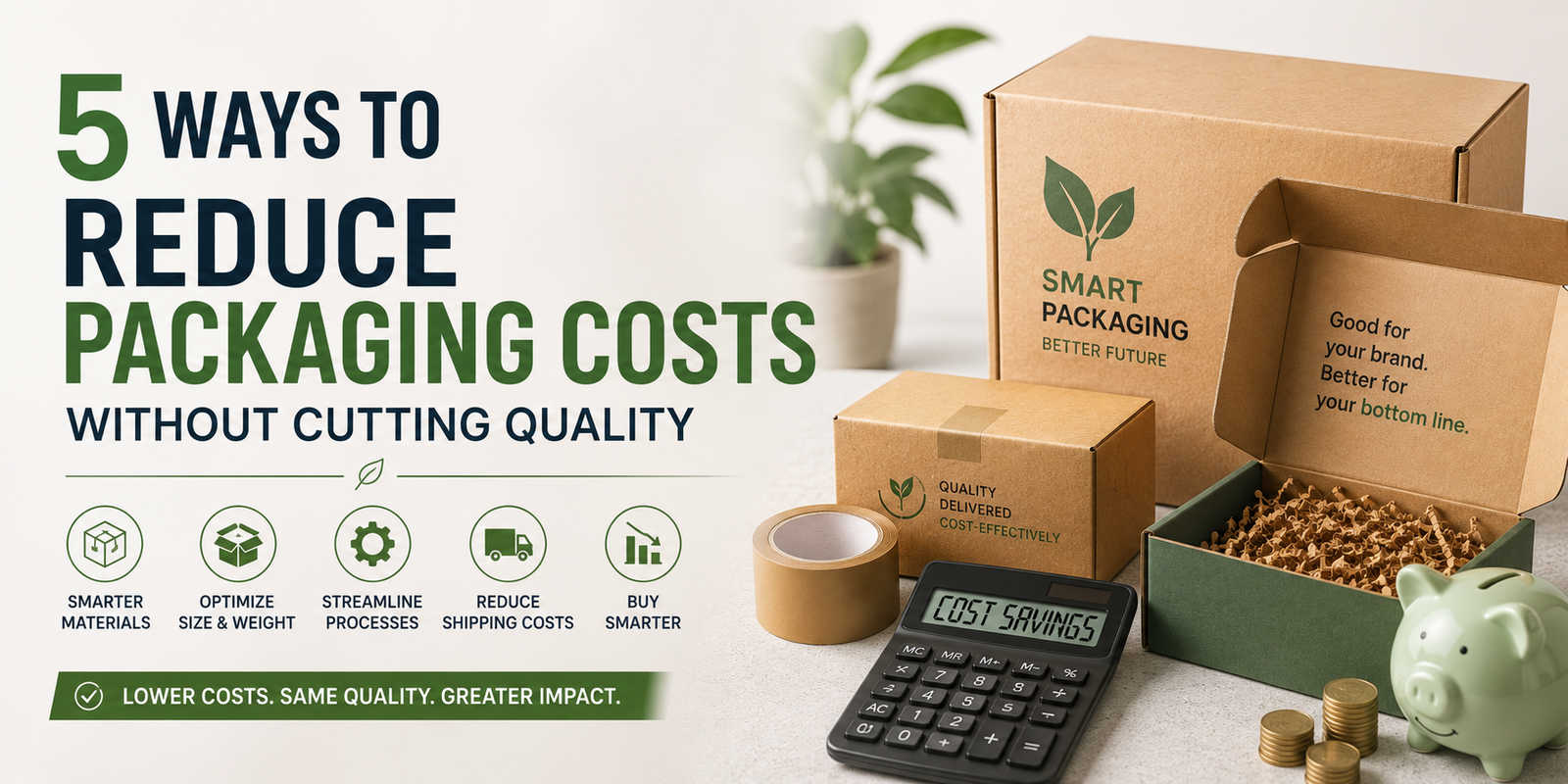
Packaging is often treated as a fixed cost — a number that simply is what it is. It isn't. For most businesses, packaging spend hides a surprising amount of waste that has nothing to do with the price per box and everything to do with how the packaging is specified, ordered and managed. The encouraging part is that trimming this waste rarely means accepting weaker protection. Here are five proven ways to reduce packaging cost while keeping, or even improving, quality.
1. Optimise the specification
Over-specified packaging is the most common and most expensive source of waste we see. Businesses understandably err on the side of caution and order a heavier board than the product needs, then keep reordering that same spec for years out of habit. Every unnecessary wall of board, every grade stronger than required, is money spent on protection the product never uses. A proper specification review matches flute, wall and strength to the product's real weight, stacking and transit conditions. Often a double-wall carton can safely become single-wall, or a premium board grade can drop a level, with no increase in damage. The savings compound across every unit, every order, every year — which is why spec optimisation almost always delivers the biggest single reduction.
2. Right-size your boxes
An oversized box costs you three times over. You pay for board you do not need, you pay for void fill to stop the product rattling around, and you pay freight on shipping air — couriers increasingly charge by dimensional weight, so empty space is billed as if it were product. Right-sizing cartons to the product removes all three costs at once. It also reduces damage, because a snugly fitted product cannot shift in transit. Reviewing your range and consolidating to a smaller set of correctly sized boxes frequently cuts both material and shipping spend by a meaningful margin, and the freight saving alone often justifies the exercise.
3. Consolidate and standardise
Fragmentation is expensive. When a business runs dozens of slightly different box sizes and specs, each one is ordered in smaller quantities, which means higher per-unit pricing, more frequent setups, more SKUs to store and more complexity on the packing line. Rationalising that range — finding the handful of sizes that cover most of your products and standardising on them — unlocks better pricing through larger runs and simplifies everything downstream. Larger, consolidated orders are simply cheaper to produce per unit, and a leaner set of standard boxes reduces the inventory and admin overhead that quietly adds cost. The goal is the fewest distinct specs that still protect every product properly.
4. Buy factory-direct
Every layer between the manufacturer and you adds a margin you ultimately pay. Distributors and resellers provide convenience, but they price in their own profit on top of the factory cost. Buying directly from the manufacturer removes that markup entirely, and it does more than save money — it shortens the feedback loop. When you deal directly with the people who make the box, specification changes, quality questions and custom requirements get resolved faster and more accurately, because nothing is lost in translation through a middle layer. Factory-direct pricing combined with direct technical access is one of the clearest ways to cut cost without cutting quality.
5. Manage inventory and order timing
How you order matters as much as what you order. Tiny, frequent orders attract higher per-unit pricing and rack up repeated freight charges. Enormous one-off orders tie up cash and warehouse space and risk damage or obsolescence if a design changes. The sweet spot is planned ordering that balances volume pricing against carrying cost — forecasting usage, scheduling production runs ahead of need, and holding a sensible buffer rather than reacting in a panic when stock runs low. Many manufacturers offer scheduled production or call-off arrangements that secure volume pricing while delivering in manageable batches, giving you the best of both. Planning ahead also avoids the premium you pay for rush jobs.
The hidden cost of damage
Any conversation about packaging cost is incomplete without damage, because damage is the most expensive line item that never appears on the packaging invoice. A crushed shipment means a replacement product, a second round of freight, the labour to process the return and reship, and — hardest to recover — the customer's lost confidence. A packaging "saving" that raises the damage rate is not a saving at all; it has simply moved the cost somewhere harder to see. This is why the smart target is total delivered cost — packaging plus damage plus freight — rather than the price of the box alone. Often a marginally better box that eliminates a recurring damage problem is the single biggest cost reduction available to a business.
How to run a packaging audit
A structured audit turns these ideas into rupees saved. Begin by listing every packaging SKU you buy, with its specification, size, annual volume and unit price. Overlay your damage data to see which products fail and why. Then look for the patterns: boxes specified heavier than the product needs, oversized cartons carrying void fill and dimensional-weight freight, near-duplicate sizes that could be consolidated, and specs that have not been reviewed in years. Test any change on a small scale before rolling it out across the range. Most businesses have simply never examined their packaging end to end, which is exactly why the first audit almost always finds the largest savings.
Build a relationship, not just a price list
Finally, the cheapest box today is not always the lowest cost over a year. A manufacturer who understands your products and supply chain can flag a spec drifting out of date, suggest a consolidation you had not considered, or warn you before a design change causes a problem on the line. That ongoing technical partnership routinely saves more than chasing the lowest quote on each individual order, because it prevents the costly mistakes a purely transactional supplier has no incentive to catch.
Where quality must not be cut
It is worth being clear about the difference between cutting cost and cutting corners. Reducing genuine waste — oversized boxes, over-specified board, fragmented orders, middle-layer markups — lowers cost with no downside. Reducing the protection a product actually needs is false economy: a single batch of damaged goods, with its replacements, refunds and lost trust, usually erases far more than the packaging saving that caused it. The aim is to spend exactly what protection requires and not a rupee more, never less. Every one of the five strategies above removes waste rather than protection, which is precisely why they work.
Putting it together
These five levers reinforce each other. Optimising the spec and right-sizing reduce material; consolidating unlocks volume pricing; buying factory-direct strips out markup; and smart ordering captures that pricing without tying up cash. Applied together, they routinely take double-digit percentages out of total packaging spend while improving consistency and reducing damage. The first step is simply to look — most businesses have never had their packaging audited end to end. We offer exactly that: a review of your current specifications, sizes, ordering patterns and supply chain to find where the savings actually are. The box that protects your product should not be quietly overcharging you for the privilege.