Choosing a corrugated box looks simple until the first batch comes back crushed, or until you realise you have been paying for twice the board you actually need. The right specification protects your product through every stage of its journey — packing, palletising, transit, storage and the final mile — while the wrong one quietly drains money through damage claims, returns and reputation. This guide walks through every decision that matters, in the order you should make it.
Start with the journey, not the box
Before you think about flutes or ply, map out what your packaging will actually go through. A box that travels 30 kilometres on a single pallet faces nothing like the punishment of a carton that is hand-loaded, stacked six high in a warehouse, shipped across the country, and then handled by a courier network. Ask yourself four questions: How heavy is the product? How will the boxes be stacked, and how high? How far and by what method will they travel? And what are the humidity and temperature conditions along the way? Your answers decide everything that follows. Over-specifying is just as wasteful as under-specifying — you are paying for protection the product never needs.
Understand the flute
Flute is the wavy, fluted medium sandwiched between the flat liners of corrugated board. It is what gives the material its cushioning and stacking strength, and the grade you choose changes the box's whole character. The common grades each suit a different job:
- A-flute — the thickest profile, around 5 mm. It offers the best cushioning and stacking strength, making it ideal for fragile or heavy items.
- B-flute — thinner at about 3 mm, with excellent flat-crush resistance and a smooth surface that prints cleanly. A favourite for retail-ready cartons.
- C-flute — the all-rounder at roughly 4 mm, balancing cushioning and printability. Most standard shipping cartons use it.
- E and F-flute — very thin profiles used for premium printed packaging, small product boxes and anything where a refined finish matters more than heavy-duty protection.
Manufacturers also combine flutes in double-wall board — a BC or EB combination, for example — to blend the strengths of two profiles in a single sheet.
Match the wall to the weight
Ply, or wall count, is the number of fluted layers in the board. Single-wall board handles the vast majority of products up to a moderate weight and is the most cost-effective choice for everyday shipping. Double-wall board steps in for heavier loads, taller stacking and export shipments where the carton must survive a longer, rougher trip. Triple-wall board is the heavyweight option, strong enough to replace timber crates for industrial parts, machinery components and bulk loads. The temptation is always to go a grade heavier "just to be safe," but every extra wall adds cost and weight. The goal is the lightest board that comfortably clears your protection requirement.
The two numbers that actually predict performance
Two test values tell you far more than the board's appearance ever will. Bursting Strength measures how much pressure the board withstands before it ruptures — useful for products that are heavy or oddly shaped and likely to push against the walls. Edge Crush Test, or ECT, measures how much top-to-bottom compression the board takes before it buckles, which directly predicts how well boxes stack on a pallet without collapsing. If your cartons spend time stacked in a warehouse, ECT is the number to watch. Ask your manufacturer for both figures and have them matched to your real stacking height and transit method rather than a generic rating.
Choose the right box style
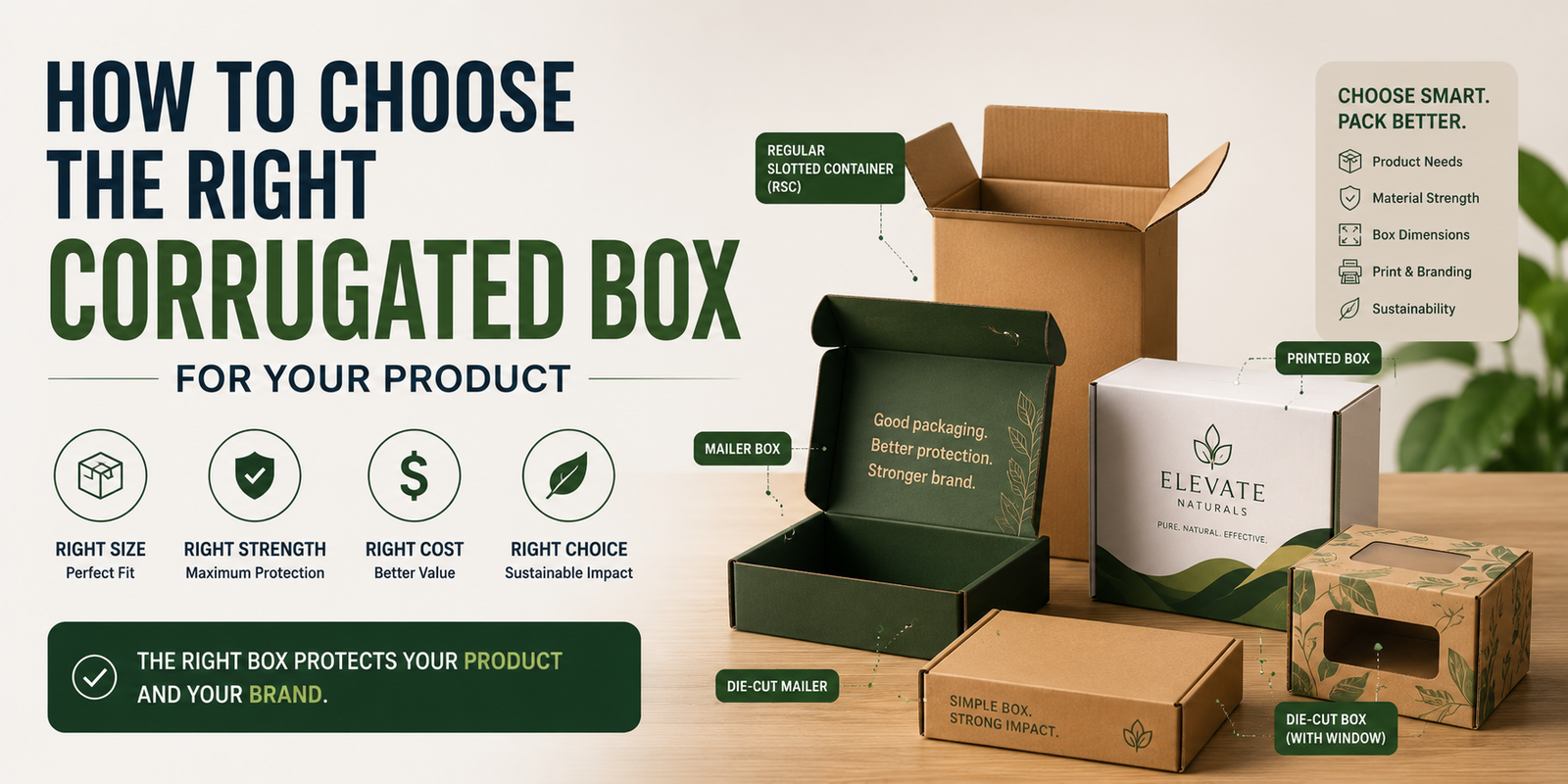
The board is only half the decision; the construction style is the other half. The Regular Slotted Carton (RSC) is the classic shipping box, economical and quick to produce, where all flaps are the same length and the outer pair meet in the middle. Die-cut boxes are cut and creased to a custom shape, ideal for retail presentation, snug product fit or self-locking designs that need no tape. Full-overlap boxes give extra strength on the top and bottom panels for heavier contents, while trays, sleeves and partition inserts solve specific protection or display needs. The right style reduces both material use and packing time on your floor.
Get the fit right
A box that is too large invites damage. Empty space lets the product shift, and a partially filled carton crushes more easily under stacking load because the product is not there to share the compression. A box that is too tight, on the other hand, bulges, strains the seams and can fail at the corners. Measure your product's length, width and height accurately, then allow a small, deliberate clearance for any inner protection — never a guess. If you are shipping multiple units per carton, work out the best count per box that balances handling weight, freight efficiency and damage risk. Right-sizing is one of the fastest ways to cut both material and shipping cost at once.
Factor in print and finish early
If your box carries branding, decide on print method before you finalise the board, because the two are linked. Flexographic printing is economical and well suited to one-to-three colour designs printed directly onto kraft, and it pairs naturally with B and C-flute. For photographic, full-colour retail packaging, litho-lamination bonds a high-resolution printed sheet to the corrugated board and works best on finer flutes. Bringing print into the conversation early avoids the common trap of locking in a board grade that fights your branding goals.
Test before you commit to a full run
The cheapest insurance in packaging is a prototype. Before committing to thousands of units, pack a real sample, seal it as it will ship, and put it through a realistic drop, compression and vibration sequence — or have your supplier run ISTA-style transit testing. A short test cycle exposes weak corners, undersized board or a poor fit while changes still cost almost nothing. It is far better to discover a problem on ten sample boxes than on ten thousand delivered ones.
Inner protection is part of the spec
The outer box is only one layer of the system. How the product sits inside often matters just as much, and it is where many otherwise sound packs fail. Fitted corrugated inserts, partitions and pads hold the product in place, separate multiple units so they cannot knock together, and spread shock away from fragile points. Choosing inner protection at the same time as the box — rather than as an afterthought — lets the two work together, and frequently allows a lighter outer board because the contents are no longer relying on the walls alone to survive handling. Specify the box and its inserts as one engineered unit, not two separate purchases, and you often end up with better protection at lower total cost.
Work with a manufacturer, not just a supplier
The difference between a box vendor and a packaging partner shows up in the questions they ask. A good manufacturer wants to know your product, your supply chain and your failure points before quoting, and then recommends the exact flute, wall and strength that fits — not the most expensive option, and not the cheapest one that fails in the field. When you share your product weight, dimensions and shipping method with our team, that is precisely what we do: spec a box that protects what matters without making you pay for performance you will never use. Get those decisions right and the box stops being a cost line and becomes part of why your product arrives, and sells, in perfect condition.