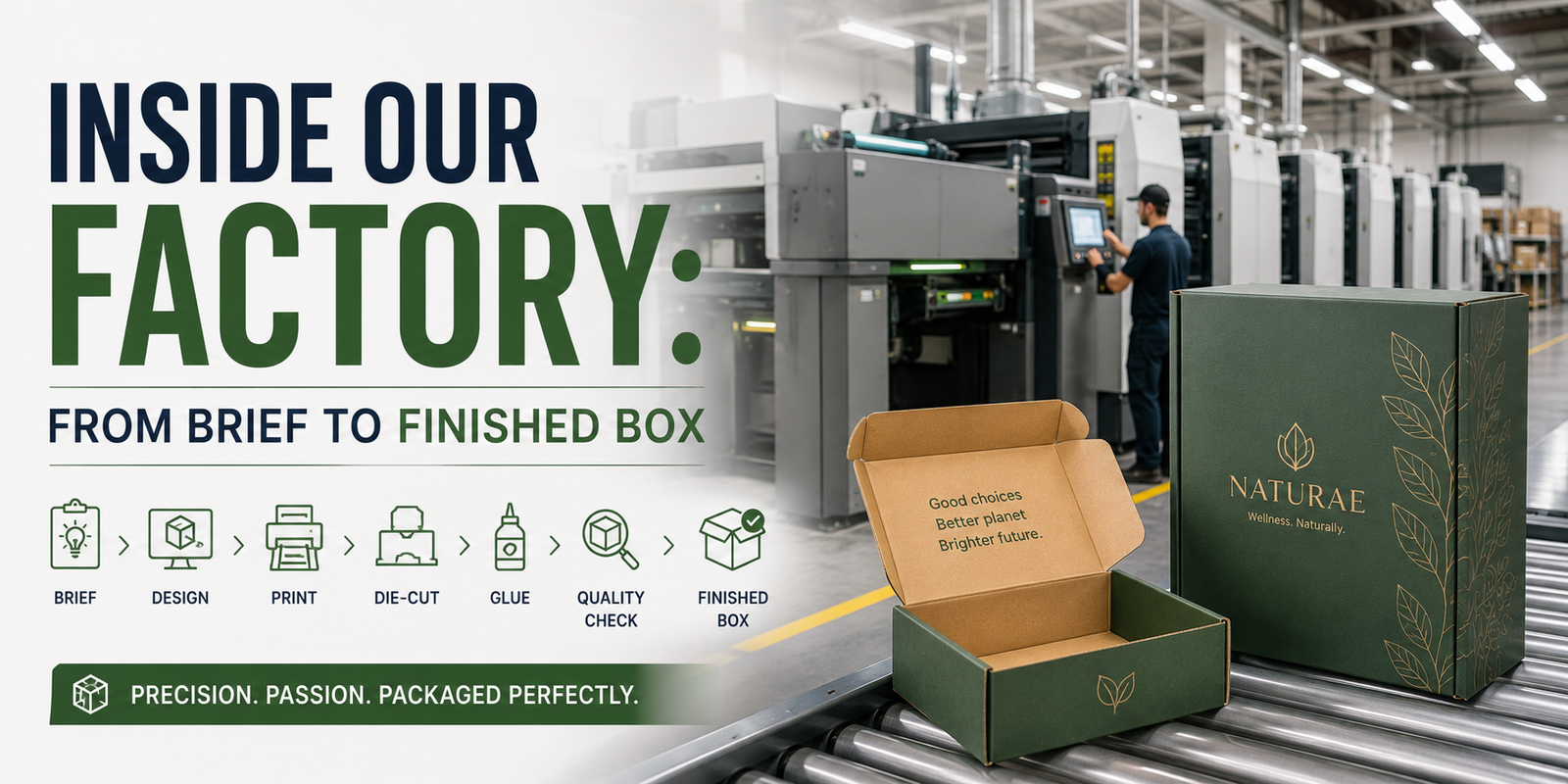
A finished box looks simple, which is exactly the point — all the engineering disappears into something that just works. Behind that simplicity sits a disciplined process where every order moves through the same seven stages, each with its own checkpoint. Understanding how a box is actually made helps you brief better, anticipate lead times and know what to expect from a serious manufacturer. Here is what happens between your brief and your delivery.
Stage 1 — Understanding the brief
Everything starts with the product, not the box. Before we design anything, we want to know what is being packed, how heavy and fragile it is, how it will be stacked and shipped, where it is going, and what the packaging needs to achieve — pure protection, retail presentation, or both. The questions asked at this stage determine whether the finished box performs or fails, which is why a good manufacturer interrogates the brief rather than simply quoting against a size. A clear, complete brief here saves time and cost at every stage that follows.
Stage 2 — Structural design
With the requirements understood, our design team develops the box's structure: the style, dimensions, flute, wall and strength that will protect the product efficiently. This is where computer-aided design earns its place, letting us model the carton precisely, calculate material use and produce a physical sample before committing to tooling. A prototype is cut and folded so the fit, strength and handling can be checked against the real product. Catching a design issue on a single sample is effortless; catching it after a full run is expensive. The sample is the moment to get everything right.
Stage 3 — Tooling and pre-press
Once the design is approved, the production tools are prepared. For die-cut boxes, a cutting die is made to the exact shape and crease pattern. For printed boxes, printing plates are produced and artwork is processed through pre-press to ensure colours, registration and crease clearances are correct. This preparation is meticulous because the tooling defines every unit that follows — a flaw here repeats thousands of times. Thorough tooling and pre-press checks are a hallmark of a manufacturer that takes consistency seriously.
Stage 4 — Corrugation
This is where flat paper becomes corrugated board. On the corrugator, the fluted medium is formed and glued between flat liners, producing board to the exact flute and wall specified for the job. Temperature, glue and speed are controlled carefully, because the quality of the board at this stage sets the ceiling on the strength of the finished box. Consistent, well-bonded board is the foundation everything else is built on; weak corrugation cannot be rescued by later steps.
Stage 5 — Printing
Branded boxes move to printing, where the chosen method — flexographic for economical solid-colour designs, or litho-lamination for premium photographic finishes — applies the artwork to the board. Colour is matched to the approved references and registration is monitored so print stays crisp and consistent across the run. For plain shipping cartons this stage is skipped, but where branding matters, this is where a box gains the presence that does marketing work long after it leaves our floor.
Stage 6 — Die-cutting, folding and gluing
The printed or plain board is now cut and creased to its final shape. Die-cutting presses the board against the cutting die to produce the exact outline and fold lines, and slotting or folding and gluing turn the flat blank into a box or a flat-packed carton ready to assemble. Precision here determines how cleanly the box folds, how square it sits and how well it locks or seals — the details that decide whether packing is quick and the finished carton looks professional.
Stage 7 — Quality control and dispatch
Quality control is not a single inspection bolted on at the end — it runs throughout, with checks at each handoff so problems are caught early rather than discovered in a finished pallet. Dimensions, print quality, strength and construction are all verified against the specification. Only once a batch passes is it counted, packed, palletised and dispatched, with the documentation and markings the shipment needs. Building inspection into every stage, rather than relying on a final gate, is what keeps quality consistent from the first box to the last.
What drives your lead time
One of the most common questions we hear is why a first order takes longer than a repeat one, and the seven stages explain it. The bulk of the upfront time goes into the early stages — understanding the brief, structural design, sampling, and making tooling and plates. These cannot be rushed without risking the quality of every unit that follows. Once tooling exists and a design is approved, repeat orders move much faster because they skip straight to production. Planning a comfortable lead time on a first order, and ordering repeats ahead of need, is the simplest way to avoid the premium and the risk that come with rush jobs.
Why consistency is the real test
Anyone can make one good box. The mark of a serious manufacturer is making the ten-thousandth box identical to the first, order after order, month after month. That consistency comes directly from the disciplined process: controlled corrugation, carefully maintained tooling, matched print references and inspection at every handoff. It is also why specification and approval matter so much at the start — the process faithfully reproduces whatever was signed off, so getting the sample exactly right is getting every future box right. When you reorder, the same controls deliver the same result, which is what lets you build your own packing, branding and logistics around a box you can rely on.
Always improving the process
A good process is never finished. We review production data, damage feedback and customer input to refine designs, reduce material where it is safe to do so, and tighten quality further. A box that performs well today can often be made lighter, cheaper or more sustainable tomorrow as materials and methods improve — but only on the foundation of a controlled, measurable process. Continuous improvement is how a manufacturer keeps your packaging competitive over time rather than letting it quietly fall behind.
From our floor to yours
The final handoff matters as much as the first. A finished batch is counted, packed to travel safely itself, palletised and dispatched with the documentation and markings your shipment needs, so the boxes that protect your product are themselves protected on the way to you. Clear communication at this stage — accurate quantities, realistic dispatch dates, proper paperwork — is part of the quality we hold ourselves to, because a perfect box that arrives late or short still lets you down.
Why the process matters to you
Seven disciplined stages, each with a checkpoint, are what stand between a reliable box and a gamble. The process is also why a serious manufacturer can promise consistency: the same controls produce the same result, order after order. It shapes lead times too — tooling and sampling take time up front, but they are what guarantee the full run performs. If you would like to see it in person, we welcome factory visits; there is no better way to understand what goes into your packaging than to watch a brief become a finished box on the floor.