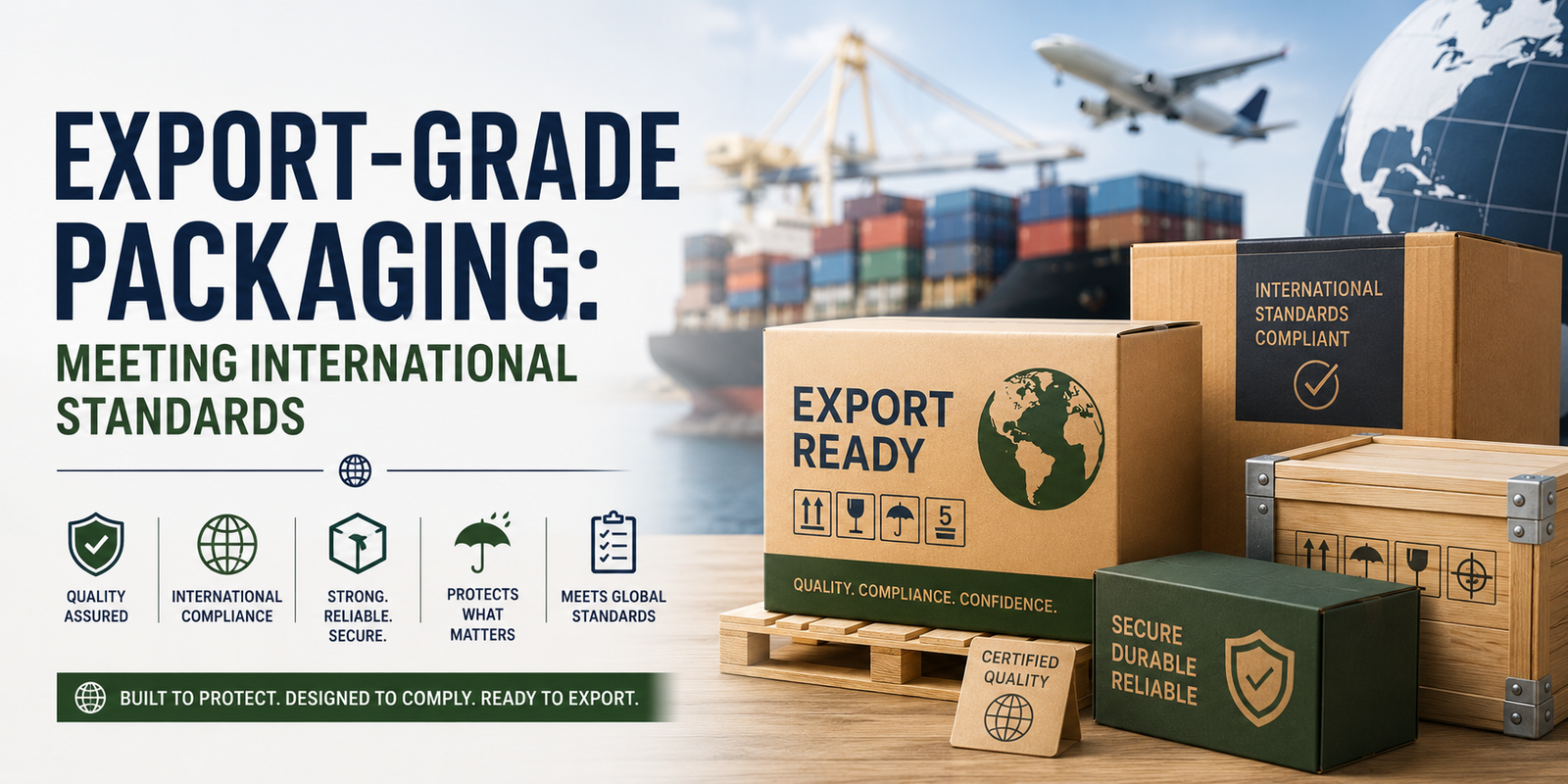
Packaging that performs flawlessly across town can fail completely on an export journey. International shipments face longer transit times, far more handling touchpoints, dramatic swings in temperature and humidity, and the scrutiny of customs in another country. "Export-grade" is not a marketing phrase — it describes packaging deliberately engineered for these harsher conditions. This guide explains what that engineering involves and the standards overseas buyers expect to see.
Design for the worst leg of the trip
The cardinal rule of export packaging is to build for the toughest conditions the shipment will encounter, not the average. A container crossing the ocean may sit in a humid hold for weeks, be lifted and dropped by cranes, stacked under enormous weight, and trucked over poor roads at both ends. If your packaging is designed for typical domestic handling, the export journey will find its weakest point. That usually means stepping up to double-wall or, for heavy industrial goods, triple-wall board, and specifying higher strength ratings than a domestic equivalent would need. The extra material is cheap compared with a container of damaged goods arriving on another continent.
Manage moisture aggressively
Humidity is the quiet destroyer of export shipments. Corrugated board loses a significant share of its strength as it absorbs moisture, so a box that tests strong in a dry warehouse can soften badly in a humid sea container. Several defences work together: moisture-resistant or wax-coated liners that resist absorption, desiccant packs inside the carton or container to control internal humidity, and moisture-barrier liners or shrink wrapping on the pallet. For sensitive goods, condition the packaging to the destination climate in mind rather than your own. Controlling moisture is often the difference between a clean delivery and a claim.
Build for stacking and compression
In a shipping container, boxes are stacked high and packed tight to use every cubic metre, which means the cartons at the bottom carry tremendous compressive load for the entire voyage. Edge Crush Test (ECT) values become critical here, because they predict how much top-to-bottom pressure a box withstands before buckling. Export cartons should be specified with stacking strength matched to the real load they will bear over time, accounting for the strength loss that humidity causes. Pallet design matters too — even weight distribution, proper stretch-wrapping and corner protection keep the stack stable through rough handling.
Respect timber and ISPM 15
If your packaging uses any solid wood — pallets, crates, bracing or dunnage — international regulations apply. ISPM 15 requires wood packaging material used in export to be heat-treated or fumigated and stamped with the recognised mark, to prevent the spread of pests across borders. Shipments with untreated or unmarked timber can be held, fumigated at your expense, returned or destroyed at customs. One increasingly popular way to sidestep the issue entirely is to replace timber crates with heavy-duty triple-wall corrugated cases, which fall outside ISPM 15, weigh far less, and cost less to ship.
Cushion and brace the contents
A strong outer case does not protect a product that is free to move inside it. Export journeys involve repeated vibration and shock over weeks, and internal movement is a leading cause of damage that arrives looking like a packaging failure. Fitted corrugated inserts, partitions, foam or moulded pulp immobilise the product and absorb the energy of handling, while bracing and dunnage stop heavier items shifting within a crate or container. For multi-unit cartons, dividers prevent products knocking against each other thousands of times over a long voyage. Engineer the inside of the pack with the same care as the outside — on an export trip, the two are inseparable.
Get unitisation and palletisation right
How cartons are grouped onto pallets has an outsized effect on whether they survive. A well-built pallet distributes weight evenly, keeps boxes within the pallet footprint so nothing overhangs and gets crushed, and is stabilised with proper stretch-wrapping, strapping and edge protection. Column stacking, where boxes sit directly on top of one another, preserves far more stacking strength than interlocked patterns, which look stable but sacrifice compression resistance. Matching carton dimensions to the pallet size to minimise wasted space improves both stability and shipping efficiency. A strong box on a badly built pallet still arrives damaged; the unit load has to be engineered as a whole, not box by box.
Plan for customs and the destination
Export packaging also has to clear a border and suit conditions you may never see. Different markets have different requirements, from labelling languages to environmental rules on materials, and a shipment that ignores them risks delays or rejection at the port. Researching the destination's expectations before you ship — and confirming them with your buyer — prevents costly surprises. Where possible, design packaging that the receiver can handle, store and dispose of easily in their own context, because packaging that creates problems on arrival quietly damages a trading relationship you worked hard to build.
Certifications international buyers look for
Overseas buyers cannot inspect your factory, so they rely on certifications as proof of consistency and quality. A few carry real weight in export trade:
- ISO 9001 — demonstrates a documented quality management system, giving buyers confidence that what they order is what they will repeatedly receive.
- ISTA transit testing — shows packaging has been tested against standardised simulations of real distribution hazards like drops, vibration and compression.
- FSC certification — increasingly required in markets with strict environmental procurement rules, proving responsible fibre sourcing.
Stated ECT and bursting-strength figures, backed by test reports, round out the picture and let a buyer specify with confidence.
Get the documentation and marking right
Export packaging is not only about physical strength; it must also clear customs smoothly. Clear, durable carton markings — handling symbols, weights, dimensions, country of origin and any required shipping marks — speed inspection and reduce the risk of mishandling. Consistent labelling that matches your shipping documents avoids the delays and queries that arise when a customs officer cannot reconcile the box in front of them with the paperwork. Smudged, missing or inconsistent marking is a surprisingly common cause of avoidable hold-ups.
Corrugated cases versus timber crates
For heavier export loads, the old default was a wooden crate — but heavy-duty triple-wall corrugated cases now match or beat timber for many applications, and they carry real advantages. They weigh far less, which lowers freight cost on every shipment. They fall outside ISPM 15, removing the heat-treatment and marking burden that wood carries. They can be printed and die-cut to fit the product precisely, and they flat-pack for storage before use. Timber still wins for the very heaviest machinery and point-load applications, but for a large share of export goods, a well-engineered triple-wall case delivers the protection of a crate without its weight, cost and regulatory friction. It is worth pricing both before defaulting to wood.
Test against the real route
The only way to be confident export packaging will hold up is to test it against the journey it will actually take. Transit testing that simulates the drops, vibration, stacking and climate of your specific route reveals weaknesses before they cause an expensive failure abroad — where a damaged shipment is far harder and costlier to put right than a domestic one. As a quality-driven manufacturer, we produce export-grade packaging engineered and tested for the conditions your goods will meet, and we help clients navigate moisture control, ISPM 15 and the certifications their buyers expect. Get export packaging right and it stops being a risk and becomes a quiet competitive advantage: your goods simply arrive, intact and on time, every time.